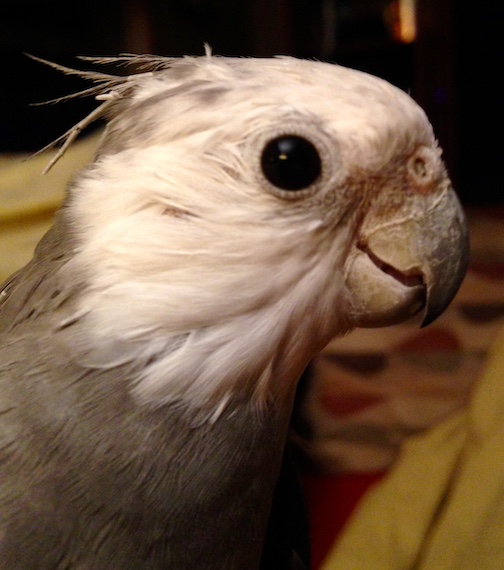
“Good morning, Squeaks,” said Momanita as she plucked off the cover of my rolly cage. “It’s a misty morning that’s freshening the air and plumping the buds. Isn’t it a wonderful spring day!”
“It’s also cloudy and gray and a sleepy morning.”
Momanita thought every morning was wonderful.
To other hootmans this sounded like squeals and whistles, but not to Momanita. She MOSTLY understood cockatiel speak. I MOSTLY understood hootman talk.

“I spied a bunny in the yard munching on clover,” said Momanita. “As soon as I stepped on the back deck, she sped off. I can’t believe that she saw me at that distance facing the opposite direction.”
“I can’t believe I’m awake for almost five whole minutes and I haven’t had a Cheerio yet!”
All this talk about a bunny eating made me hungry.
“I wonder how the bunny’s sight is different from other animals,” said Momanita.
When Momanita wondered, she thought of questions.
When she thought of questions, she looked for answers.
When she looked for answers, she needed my help.
“Let’s look it up,” said Momanita. “I’ll bring the Cheerios.”
She had me at Cheerios. I climbed out of my rolly cage into my writing nest. Momanita climbed the stairs to HER writing nest. She scooted her chair to the computer and tapped the keyboard. I perched on top. Momanita fed me Cheerios. The morning became more wonderful with each Cheerio bit.
Eyes In The Back Of Your Head
“No wonder, bunny saw me,” said Momanita. “Bunnies can see behind them without moving their heads!”
Momanita had been reading about bunnies and eyes for a while. I polished off a half dozen Cheerios while she tapped the keyboard and stared at the screen.
“I can see what’s behind me. That’s how I watch the ping pong ball when it chases me.”
I don’t like ping pong balls. They’re scary.
“Prey animals’ eyes are on either side of the head so they are able to see a wider range and be alert to danger,” said Momanita. “Rabbits and parrots can see completely behind them because of the way their skulls are formed.”
“My skull is rather fascinating, just like my crest on top of it.”
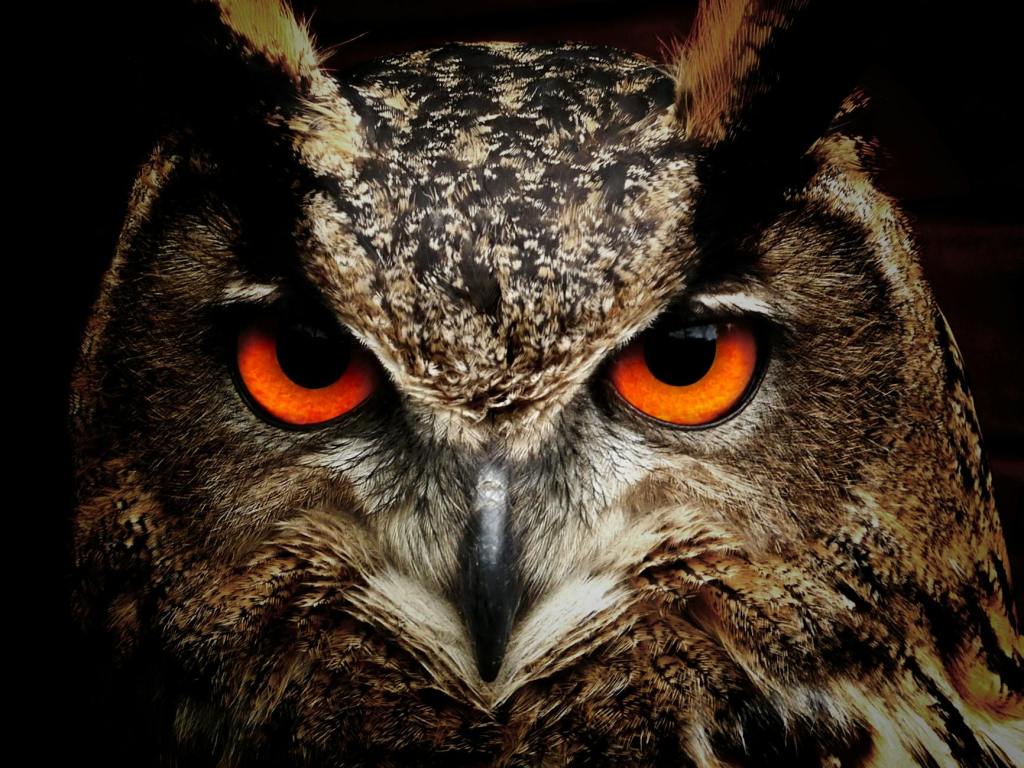
“Predator animals have their eyes in front of their heads. This gives them binocular vision. It helps them figure out how far away a prey animal is,” said Momanita. “It makes them better hunters.”
“Terror birds are predators. Owls scare me more than ping pong balls.”
“There’s a rhyme that helps remember the difference between the two,” said Momanita. “’Eyes on the side? Hide! Eyes on the front? Hunt!”
“I know to hide when I see a terror bird (or ping pong ball). I don’t need a rhyme.”
Not Starry Eyed
“The location of the eyes helps us understand animals and how they survive,” said Momanita, “but the pupils do, too.”
I didn’t think Momanita meant her students. She retired from teaching a long time ago.
“Listen to this, Squeaks,” said Momanita.
“All this listening is making me hungry.”
Momanita didn’t hear me, She kept reading. She didn’t give me more Cheerios.
“The pupil is the part of the eye in the middle of the iris (colored part) of the eye,” said Momanita. “It lets in light.”
“It’s hard to listen when I’m hungry.”
“Pupils come in different shapes. A cuttlefish’s is “W” shaped, a dolphin’s is a crescent, and some frog’s are heart-shaped.”
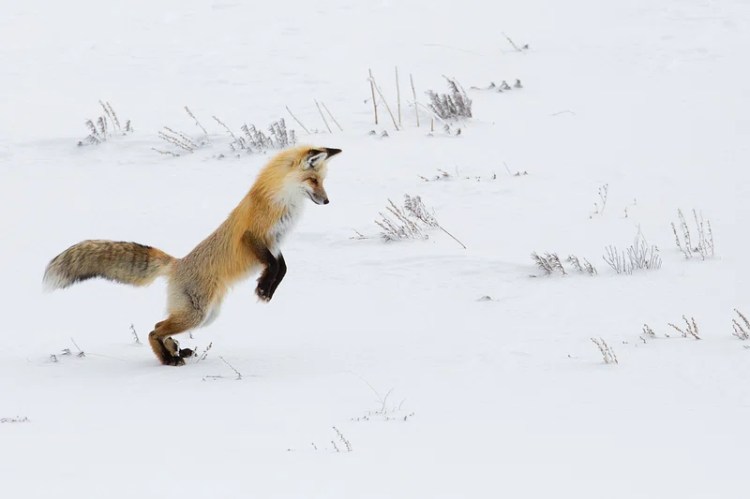
“Short predators like foxes have vertical pupils,” said Momanita. “A fox is an ambush predator. It waits. Then jumps out on prey. Taller predators like wolves have round pupils. They chase when hunting. Both shapes help them figure out distance. If they can’t do that, they’ll go hungry.”
“I’m going hungry now. Cheerios?”
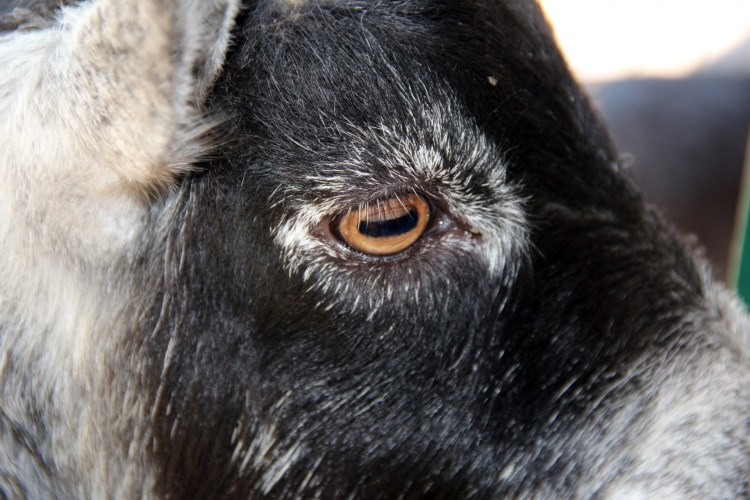
“Prey animals like sheep and goats have horizontal pupils,” said Momanita. “This helps them see in all directions.”
“I see Cheerios in your pocket. Should I pouch on them or chase them down?”
Turn A Blind Eye
“Then there are animals that are blind,” said Momanita. “They live in dark places. So, they don’t need to see.”
“I survive even though I can’t fly. I’d survive better with a few of those Cheerios”

“Cave beetles live in caves, the yeti crab lives deep in the Pacific Ocean, and golden moles live underground. All of their homes are dark,” said Momanita. “They use touch and hearing to find food and move around safely.”
“I hear some Cheerios calling me.”
“I see through eyes and I see animals’ eyes,” said Momanita. “There are so many different ones. I’m amazed at how much I didn’t know. Maybe we should write about how eyes help us survive.”
I climbed down the side of my writing nest and up Momanita’s arm. Momanita slipped her hand into her pocket and retrieved a handful of Cheerios just like I knew she would.
“Let’s write about how people, animals, and the world are more than meets the eye. We should take time to understand them.”
To other hootmans this sounded like squeals and whistles, but not to Momanita. She MOSTLY understood cockatiel speak. I MOSTLY understood hootman talk.
Check out Momanita’s book OPERATION HOPPER.
Momanita and I read about animal eyes. You might want to read about them, too.
 Anita Borgo